David Sorensen

I'm an Economics, Mathematics, and Computer Science triple major at the University of Maryland. I've just finished a research internship at the Federal Reserve Board, and I'm currently writing two papers over my senior year. My interests are in the intersection of data science and economic research. I plan to graduate in May 2027 with the goal of either pursuing a Ph.D. in Economics or a career in data science.

Education

University of Maryland, College Park

B.S. in Economics and Mathematics
B.S. in Computer Science (Machine Learning Track)
GPA: 3.67
Relevant Coursework
  • Economics: Computational Macro (PhD), Advanced Econometrics, Micro & Macro Theory, Game Theory, Behavioral Econ
  • Mathematics: Math Camp (PhD), Multivariable Real Analysis, PDEs, Mathematical Statistics, Probability Theory
  • Computer Science: Deep Learning, AI, Data Visualization, NLP, Numerical Analysis, Applied Linear Algebra, Algorithms
August 2023 - May 2027

The Avalon School

GPA: 4.7

Valedictorian

September 2019 - May 2023

Experience

Economic Research Intern

Federal Reserve Board · Washington, DC

Assisted the Senior Associate Director of International Finance, Matteo Iacoviello, on his Geopolitical Risk Index, contributing to the validation and methodology sections of the research paper.

  • Deployed Llama-3.1-8B with 4-bit NF4 quantization on a single Tesla T4 GPU on AWS SageMaker; engineered a batched inference pipeline (left-padding, attention masking, batch-size tuning) and benchmarked per-article cost and throughput against the paper's GPT-4o-mini pipeline, scoring 90,000+ articles across four historical crisis windows
  • Replicated the paper's human-validation exercise across open-source and proprietary LLMs; identified an information asymmetry between human annotators and the LLM, then designed and ran controlled reruns on 1,050 human-labeled articles to categorize human-AI disagreements
  • Conducted QLoRA fine-tuning learning-curve experiments over nested train-test splits and multiple random seeds, with chain-of-thought and few-shot ablations, establishing that zero-shot inference with the base model outperformed all fine-tuned configurations
  • Built a two-timescale steady-state Kalman filter estimating latent daily country-level risk from irregular news coverage, deriving precision-weighted gains from Fisher information and calibrating decay rates to hand-labeled conflict episodes
May 2026 - August 2026

IT Student Worker

University of Maryland · College Park, MD
  • Resolved 2,500+ Jira tickets across device onboarding, network diagnostics, printer support, and event assistance
  • Delivered real-time assistance through walk-ins and phone consultations, communicating with clients while troubleshooting under time pressure
  • Produced instructional videos and website updates to improve self-service resources for students and staff
June 2024 - May 2025

AI Software Developer Intern

Intellectmap · Rockville, MD
  • Transitioned the company chatbot from the OpenAI API to an open-source large language model, enhancing privacy and cutting API fees
  • Embedded company-specific data into the chatbot using retrieval-augmented generation
  • Created an automated mapping system using extensive C# and Excel functions to convert geographic data into coordinates on customizable map projections
August 2023 - June 2024

Math Tutor

The Avalon School · Wheaton, MD
  • Tutored over 50 high-schoolers, developing their academic confidence and enabling them to pass their courses
July 2021 - July 2023

Research

The Household Rate-Exposure Channel of Monetary Policy

Honors Thesis · Advisor: Borağan Aruoba · Current Draft
  • Measuring who bore the 2022-23 rise in credit card interest costs relative to household income and liquid buffers, using a shift-share exposure measure interacting pre-determined balances with prime rate changes in the PSID and SCF
  • Decomposing each household's balance-sheet exposure to the tightening (card interest, deposit interest, mortgage lock-in, inflation erosion of nominal debt, basket inflation) into sufficient statistics (Auclert, 2019) from PSID and SCF balance sheets, with Rubin's rules and replicate weights for SCF implicates
  • Constructing household-specific inflation rates from 31 PSID expenditure components mapped to category CPI series and a regularized cross-fitted permanent-income index to split incidence by liquidity, permanent income, and mortgage tenure
  • Running pre-specified power diagnostics, then reporting double/debiased machine learning and causal forest (grf) estimates in R as bounds with honest CIs after a zero-dose placebo exposed an interview-timing effect
  • Building a reproducible R pipeline (renv, Quarto) that links eight PSID family files (2009-2023) into a household panel, with a joint two-stage bootstrap for generated-regressor inference and Adão-Kolesár-Morales shift-share standard errors

Optimized Keyword Retrieval for Two-Stage LLM Classification Pipelines

  • Lead author of a methods paper with two Federal Reserve Board coauthors; building a Python tool that compiles an LLM yes/no classification prompt into an optimized Boolean keyword query executable on SEC EDGAR full-text search
  • Formalizing retrieval as cardinality- and budget-constrained maximum coverage (NP-hard, monotone submodular); deriving finite-sample uniform deviation bounds and characterizing three out-of-sample failure modes (optimism, budget violation, saturation) with a corrective for each
  • Building the solver: variance-regularized log-odds screening, greedy/GRASP construction, 1-for-1 swap local search, and iterated local search under lexicographic acceptance on a depth-weighted submodular objective
  • Designing the evaluation on a firm-year panel of 10-K/10-Q filings labeled by an LLM under three prompts (tariff exposure, refinancing pressure, labor constraints), with firm-level (CIK) cross-fitting and filer-clustered standard errors to prevent boilerplate leakage, and temporal splits to measure distribution shift
  • Engineering a reproducible, rate-limited EDGAR ingestion pipeline (quarterly-index sampling frame, SHA-256 replication manifest, no redistributed text) and validating emitted queries against the live EFTS API for realized coverage

Leadership

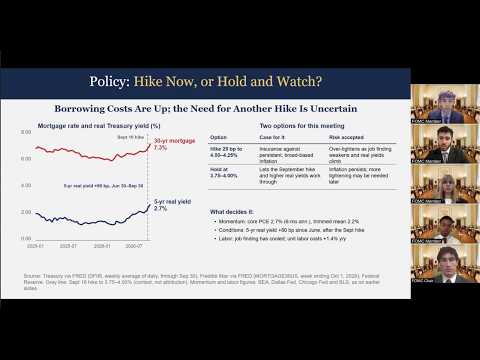
College Fed Challenge

College Fed Challenge

  • Director of the University of Maryland's College Fed Challenge team, competing in 2025 and 2026 in a Federal Reserve-sponsored undergraduate competition simulating FOMC deliberations
  • Lead a five-person presenting team and roughly 40 student researchers across four research groups
  • Played the role of FOMC Chair, presenting the team's thesis, forecast, and policy recommendation
  • Estimated the effects of international shocks on U.S. inflation and activity, including the spread of a Middle East energy-price shock across inflation categories and tariff pass-through to consumer prices, alongside analysis of terms of trade, option-adjusted spreads, labor productivity, and capacity utilization

Projects

Location Quotient Visualization

Location Quotient Mapping with LinkedIn Job Data

  • Developed an automated data pipeline using Python and the OpenAI API to process and classify 124,000+ jobs posted on LinkedIn, achieving granular industry and ownership categorization across all U.S. states
  • Engineered and maintained a comprehensive Excel dataset containing 9,000+ data points tracking state-level employment metrics and industry concentration parameters
  • Built an interactive web application in R using Shiny and Plotly libraries to create dynamic heat maps with custom color scaling and hover-based state analytics
AWS Cloud Resume

Building and Hosting this Website through AWS

  • Built a static website with HTML, CSS, and JavaScript, hosting it with an Amazon S3 bucket
  • Deployed the website as a CloudFront distribution, using an HTTPS protocol, and created an alternate domain name using Route 53
  • Created a DynamoDB table to track the number of website views which gets updated with a Lambda function written in Python and is displayed on the website using JavaScript
  • Implemented Infrastructure as Code with Terraform for programmatic access to the AWS console
  • Maintain CI/CD by pushing changes to the website with GitHub
Azure Sentinel Honeypot

Azure Sentinel Honeypot SIEM

  • Used custom PowerShell script to extract metadata from Windows Event Viewer to be forwarded to third party API that derives geolocation data
  • Configured Log Analytics Workspace in Azure to ingest custom logs containing geographic info
  • Configured Custom Fields in Log Analytics Workspace with the intent of mapping this data in Sentinel
  • Configured Azure Sentinel (Microsoft's cloud SIEM) workbook to display global attack data (RDP brute force) on world map according to physical location and magnitude of attacks
Active Directory Home Lab

Active Directory Home Lab

  • Simulated a Windows networking environment used by organizations by housing Active Directory on a virtual machine as a domain controller
  • Created two network adaptors on domain controller for the internet and internal clients
  • Assigned IP addressing, configured NAT, routing, and DHCP for the internal server
  • Created 1,000 users on the internal server with a PowerShell script
  • Connected another virtual machine to the internal server and logged in as one of the users

Skills

Programming Languages

Python, R, MATLAB (Dynare, OccBin), Stata, EViews, SQL, LaTeX, C, Java, Rust, C#, HTML/CSS/JavaScript, x86 Assembly, OCaml, Prolog, Ruby, PowerShell

Developer Tools

AWS (SageMaker, S3, CloudFront, Lambda, DynamoDB, Route 53), Azure, Terraform, Git, renv, Quarto, Jupyter, VS Code, Eclipse, Jira, Excel

Libraries

Pandas, NumPy, Matplotlib, Seaborn, Scikit-learn, PyTorch, Hugging Face Transformers, PEFT/QLoRA, bitsandbytes, grf, ggplot2, Shiny, Plotly, OpenAI API


Certifications